 Petra Pan Film
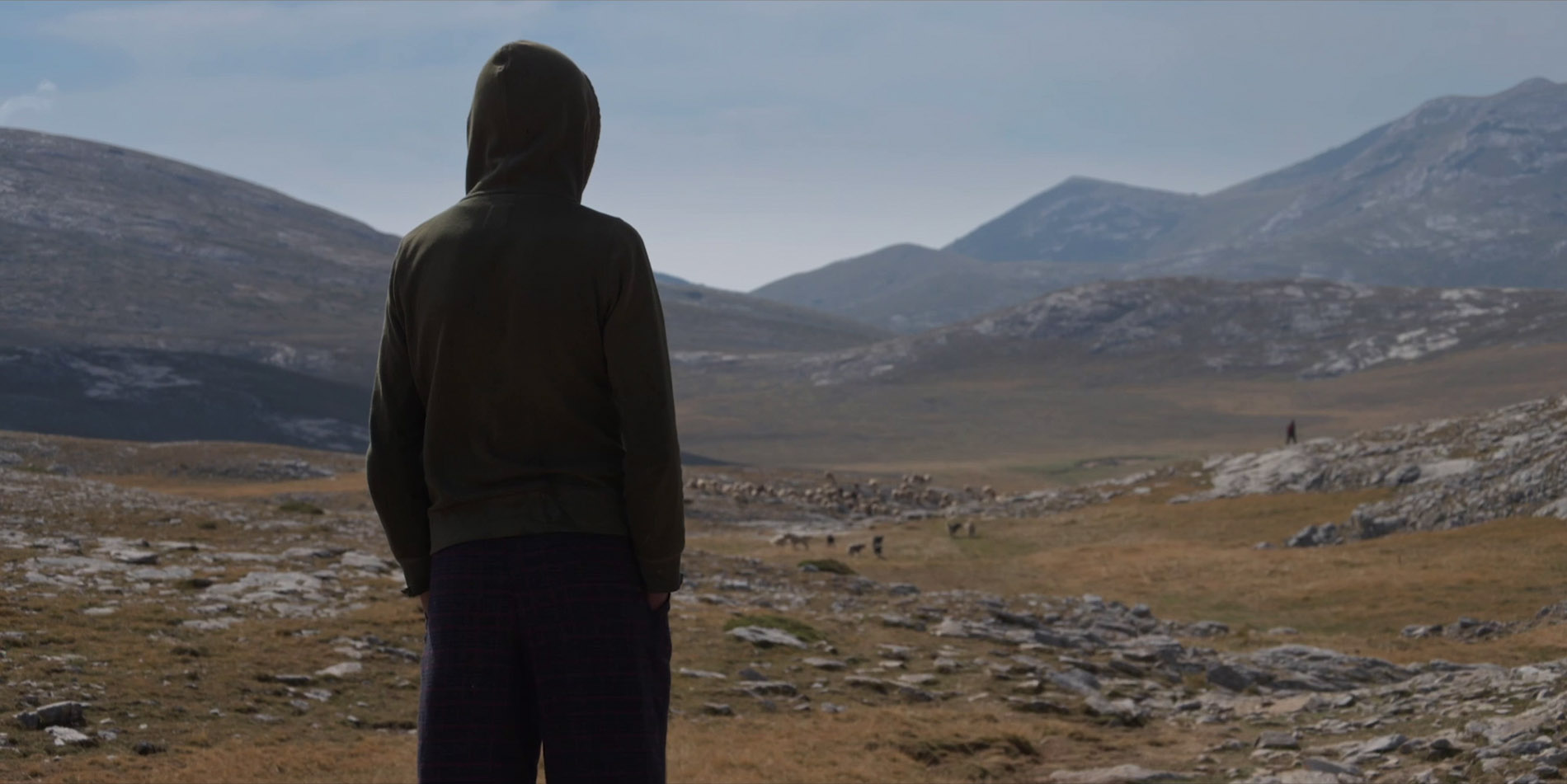
A film by Petra Seliškar · 2025
The Mountain
Won't Move
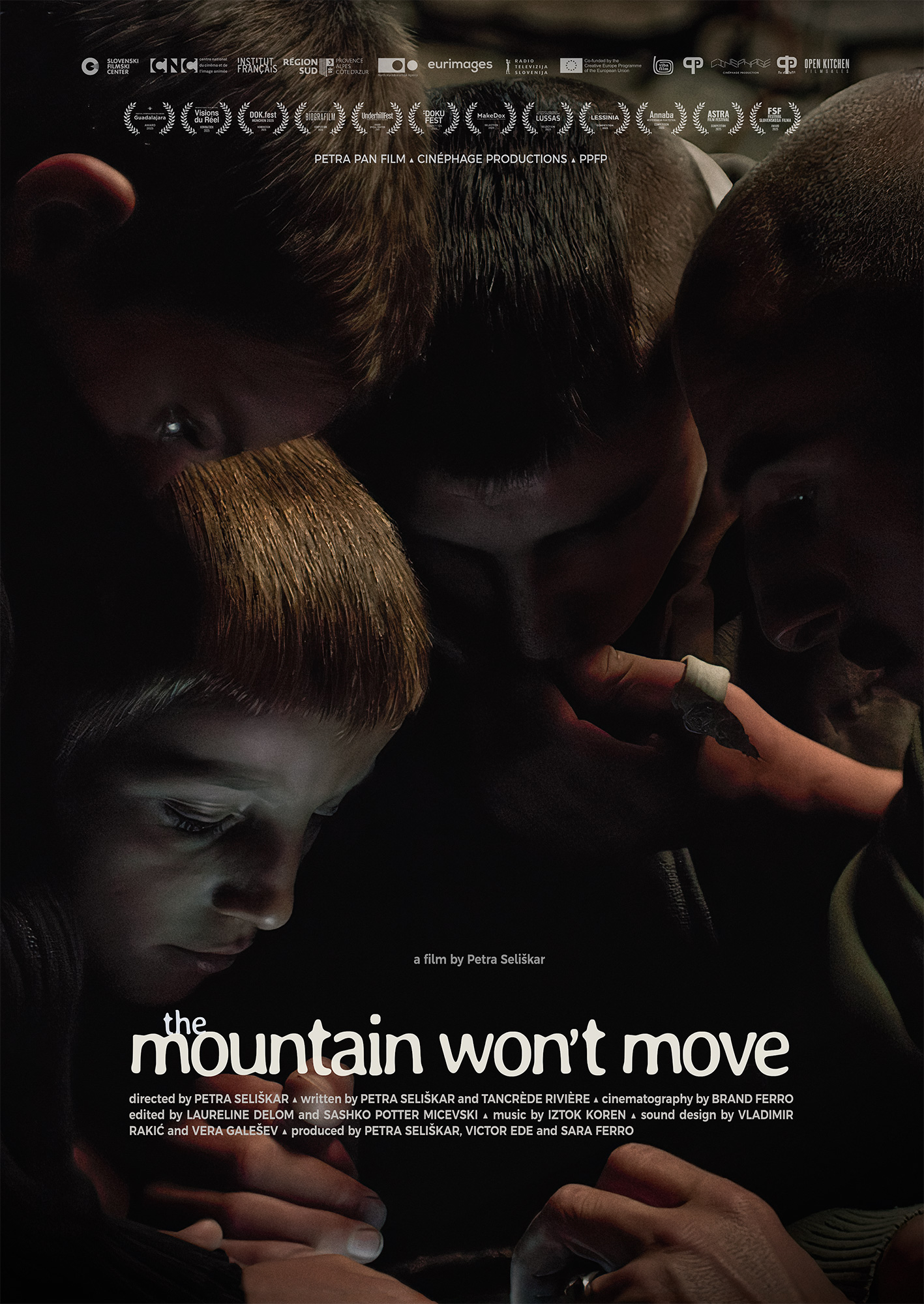
In the Macedonian mountains, three brothers with their unique shepherd dogs keep up a centuries-old tradition, torn between their way of life and dreams of a different future.





- Country
- Slovenia, France, North Macedonia
- Year · Length
- 2025 · 91 min
- Genre
- Creative documentary
- Language
- Macedonian, Albanian
- Subtitles
- English, French, Slovenian, Macedonian
- Format
- DCP · colour · 2:1 · 5.1
- World premiere
- Visions du Réel, Nyon, April 2025
- World sales
- Open Kitchen Films
High in the Macedonian mountains, amid a flock of 600 sheep guarded by huge dogs, stands a refuge. Children's laughter echoes from the precarious shelter. They're brothers between the ages of eight and twenty. When they're not working, they play and discuss the meaning of life. Is this where their future lies?
Each year, three brothers, Zekir, Zarif and Zani, spend several months in the Macedonian mountains, looking after their family's flock. The older brothers, Zekir and Zarif, lead the sheep in the upper pastures, while the younger, Zani, stays in a lower hut and takes care of the cows.
At an altitude of 2,400 metres, far from any community or society, the brothers live a free yet precarious life, filled with hard work, simple games and innocent joy. Aside from their two much younger siblings, whom Zekir tries to teach the trade, and a younger sister who occasionally visits Zani, the boys' only companions are their numerous shepherd dogs. One of them, Belichka, Zarif's favourite dog, is held captive by a breeder from the city who made a dubious agreement with the boys.
As they come of age, many questions arise in the brothers' minds: who are they, individually and in relation to each other? Can they manage a sustainable life as shepherds? What lies ahead for them in their future? As tensions grow between Zekir and Zarif, the latter becomes eager to change his life.
Sibling film My Summer Holiday The same mountains, the same family of shepherds, seen through the eyes of eight-year-old Basri. A film for young audiences. 2025 · 54 minRecognition
- Prešeren Fund AwardSlovenia's national award for artistic achievement · Petra Seliškar, for The Mountain Won't Move and Body2026
- Big Stamp Award, Best Regional FilmZagrebDox, Croatia2026
- Iris Award for Best Documentary CinematographySlovenian Association of Cinematographers · Brand Ferro2026
- Štiglic's View Award for Best DirectorDirectors Guild of Slovenia · Petra Seliškar2026
- Special Mention of the JuryUlsan Ulju Mountain Film Festival, South Korea2026
- Grand PrixFestival of Slovenian Film, Portorož2025
- Vesna Award for Best DirectorFestival of Slovenian Film, Portorož · Petra Seliškar2025
- Vesna Award for Best EditingFestival of Slovenian Film, Portorož · Laureline Delom, Sashko Potter Micevski2025
- Art Cinema Network of Slovenia AwardFestival of Slovenian Film, Portorož2025
- Grand PrixFestival International du Film de Montagne d'Autrans, France2025
- Best Socio-Environmental Film / Art Cinema Network AwardGuadalajara International Film Festival, Mexico2025
- Special Mention of the JuryUnderhillFest, Podgorica, Montenegro2025
- Special Mention of the JuryDOKUDOC, Maribor, Slovenia2025




2026
- ZagrebDox, Croatia · Regional Competition
- Kraków Film Festival, Poland · The Balkans in Focus
- Doxumentale, Berlin, Germany
- Days of Slovenian Film, Bitola, North Macedonia
- Festival International du Film de Nancy, France · Official Selection
- Manaki Brothers International Cinematographers Film Festival, North Macedonia
- Ulsan Ulju Mountain Film Festival, South Korea
- Innsbruck Nature Film Festival, Austria
- Festival of Mountain Film, Slovenia
- Festival dei Popoli, Florence, Italy
- Olhares do Mediterrâneo – Women's Film Festival, Lisbon, Portugal
2025
- Visions du Réel, Nyon, Switzerland · World premiere, International Feature Competition
- DOK.fest München, Germany · German premiere, Coming-of-Age, nominated for the SOS-Kinderdörfer Award
- Guadalajara International Film Festival, Mexico · Socio-Environmental Competition
- Biografilm Festival, Bologna, Italy · Italian premiere, Contemporary Lives
- UnderhillFest, Podgorica, Montenegro
- MakeDox, Skopje, North Macedonia · Macedonian premiere
- DokuFest, Prizren, Kosovo · Balkan Dox
- Film Festival della Lessinia, Italy
- Les États généraux du film documentaire, Lussas, France · Open-air screening
- Annaba Mediterranean Film Festival, Algeria · Official Competition
- Astra Film Festival, Sibiu, Romania
- Festival of Slovenian Film, Portorož · Feature Documentary Competition
- DOKUDOC, Maribor, Slovenia · DOKU Multikulti
- CinEast, Luxembourg · CinéDocs
- Festival du film slovène, Paris, France
- RIDM, Montréal, Canada · North American premiere, Panorama
- Gijón International Film Festival, Spain · Official Selection
- FilmAmed Documentary Film Festival, Diyarbakır, Türkiye
- European Film Festival Palić, Serbia
- Heimat Europa Film Festival, Germany
- Festival International du Film de Montagne d'Autrans, France
- Ultra Cinema Art Festival, Ferrara, Italy
“A film of generous and unhurried observation.”
Carmen Gray, The Film Verdict
“The end result is nothing short of amazing on a sensory level.”
Cineuropa
“A glimpse of a vanishing world.”
Astra Zoldnere, Modern Times Review
From the film
Stills © Petra Pan Film
Petra Seliškar
How did you discover the protagonists? Where exactly is the story taking place?
In 2017, my friend, Finnish producer Kristiina Pervilä, came to MakeDox, a documentary film festival that I was organising in Skopje. She asked Brand Ferro, who was later the DoP on the film, to help her find working Šarplaninac dogs, also known as Sharr dogs, that she was fascinated with. This is only possible up on the Šar Mountains. Marjan, a breeder and later one of our protagonists, took her on horseback to Solunska Glava, the highest peak. When she came back four days later, by the look on her face I immediately knew there was a story to be told. Actually, not so much a story but a possible way of life that exists so close to ours, and which we know so little about.
The Zekirov family are outcasts in their own community. They live an ascetic and traditional life, too much so even for the inhabitants of their home village, Gorno Jabolčište, closest to Solunska Glava. It's a huge village, with a thousand kids in the school, and at least one member of each family works abroad. They mostly identify as Albanian, while the Zekirov kids aren't even sure how to spell their name.
The boys really live in bachilos, makeshift huts on different altitudes of the mountain, with the sheep and the dogs, and go to the village maybe five times a year. They are simple farmers from the earth, not oriented towards financial gain but living a full life and having good relationships with everyone. This is partly because this is all they have ever known and was passed on to them from generations of shepherds before them. Such pure and honest souls are rare.
How did you approach them when you started to make the film?
Initially we didn't even know where exactly to find them, these mountain plains are huge and they could have been anywhere. We came to Gorno Jabolčište and inquired, we were lucky and soon found them. It all went smoothly, the father and the grandfather immediately agreed that we can film the kids, maybe because we brought our own kids along. At first I came there with my Western, urban attitude, with questions such as, where are their parents, do these kids go to school, why are they working, look at their living conditions… But they were very open to us. After spending five summers with them, I learned so much about my misconceptions of being a mother: wanting the best for your children but also causing harm to their personal growth by not teaching them how to survive and fail, how to make mistakes.
Was it your conscious decision to not show their parents?
We filmed them all except for the mother, they asked us not to. She doesn't feel comfortable on camera, and also has her hair covered. I opted against showing this aspect of them being Muslim, which is very visible in the village where also the father and grandfather move about, because the family is not very religious and it's not the point of the film. It might mislead the audience into a social-political angle that's really not the issue in their lives nor it is relevant for their lifestyle that I wanted to depict. It was far more interesting to me what these shepherds think about and how they live in close connection to the nature and animals. I was also, as a woman, observing the nature of men in their childhood, adolescence and adult behaviour. It felt as if instead of three boys I was seeing one in different periods of his life, but they are all very different. I felt I was seeing them from a perspective of filmmaker but also of a mother, and understood it was OK if their mother was not present.
This is a very remote area, how did the filming go? How long did you stay with them?
There are no roads there, no mobile network, driving up there even in an off-road vehicle is difficult as after the snow melts, it leaves the barely existing paths very rough, over many huge rocks. Sometimes it takes eight hours to cross 20 km on this terrain, especially if it rains; once we got stuck even in a military vehicle designed especially for such purposes. When it snows, you simply have to wait it out and sometimes that can take a week. We visited them many times over five summers, sometimes staying for a week or two, and in the last two years with a crew of eight people, which is rather large for a documentary production. This was necessary because of this difficult access and the need to adjust to the weather.
“To hear a thunderstorm on a mountain where there is nowhere to hide can only be described by sound.”
How did you approach the visual aspect in such a magnificent location?
I am very happy with the work of Brand Ferro and both second camera operators, Gjorgji Klincharov and Branko Avramovski. They were shooting on rough terrain, among nettles and aggressive dogs. The temperature there sometimes changes 40 degrees from night to day. There was a lot of action so it wasn't easy, especially for boom operator Jules Valeur who had to turn his work into a kind of an amazing ballet. Shepherds' daily activities are repetitive: they wake up, feed the dogs, take the sheep out and return for dinner. But the boys are so fast and used to the terrain, it was hard to catch intimate moments. It wasn't easy to plan and it took a lot of time and observational skills. This film was like an improvised choreography, with two cameras avoiding each other and the sound operator, in an impossible-to-control set of four kids, 30 dogs and 600 sheep.
How did you approach the sound design, with all the natural sounds that your microphones must have caught?
My main goal was not to tell a big story of the last shepherds in Macedonian mountains, but rather to feel how it is to live this life, from all angles, how does it convey to be a working dog, a child or a teenager growing up there. In order to touch this disappearing world, you have to become a part of it, and that is what I was interested in. To hear a thunderstorm on a mountain where there is nowhere to hide can only be described by sound. I work with Vladimir Rakić as sound designer on most of my films, and it was a long and intensive process in editing with Laureline Delom and Sashko Potter Micevski.
How would you describe this editing process?
I would say it was a kind of filigree editing. After a long time in the process with Laureline and producer Victor Ede, we realised that the plot should be simpler and focus on the human-dog relationship and relationships among siblings. They are pure and no extra drama is needed, they are all really special just as they are and it was a privilege to observe them and be with them.
How about the music?
In the last stage I invited Slovenian musician Iztok Koren to join the team. We had a long discussion whether we needed a score or not, but he did a great job. He played all the instruments and I got to sing in my film, together with foley artist Vera Galešev. We tried to portray the woman's touch they are longing for. In this remote place, staying for 3–4 months alone on the mountain brings up all kind of aspects of male frustration, but also on the level of the younger boys who are missing their mother.
Tell us something about this unique dog breed and how it ties in with this way of life.
For the brothers, the dogs are at the same time a business, a tool, but also companions. Karabash Sharr dogs are the oldest breed that are in the family for many generations. Belička, Zarif's favourite, is the most perfect dog by cynology standards; there are not many working Karabash dogs left. They have a distinctive black mouth and are the most reliable in terms of guarding and fighting wolves, they are obedient and caring.
Belička is a family treasure, and when Marjan took her to Skopje it started a big argument between the brothers. Dogs stick to their masters and it was clear that Zarif's connection with Belička was strong, so when she was taken away, he lost interest in this business.
Their real purpose is to stay on the mountain because this is the only way to have dogs freely guarding their sheep. Mountains are their home and they can't function among large groups of people, so there is no way to have these dogs in the village. So the brothers stay in one bachilo during the summer and another one for the winter. The main reason they continue to have a strong dog pack is because no wolves can touch their sheep. It happened that a wolf killed 30 sheep, not for food but just to get revenge on the dogs.
How do you see the fact that this way of life is slowly disappearing?
Will they keep this precious knowledge and lifestyle? I can only pray to all the mountain gods to keep them there but I simply don't know. I know it is like a domino effect: if one leaves, others can't handle it without him.
For Zarif and Zekir it is important to find their balance, they were brought up not to be rebellious. Zekir and Zarif now work for younger brothers, and when they are too old for this, the younger brothers will work instead of them. But if they don't have kids before they are 30, the gap will be too big to continue this way. As Zekir says, the mountain won't move, and I can only hope that they will stay, the tradition will continue and I am waiting to be invited to a wedding.
Petra Seliškar
Petra Seliškar is a Slovenian documentary writer, director and producer with a rich experience and singular talent. She has flourished as a filmmaker with profound insight, sensibility, strong narrative force and innovative approaches. Seliškar has the ability to recognise hidden details, and through them discovers and highlights the essence in art, culture, nature and all aspects of life. She is currently filming her seventh feature-length documentary, Torso of an Old Cat.
Besides her own works, Seliškar has produced films by acclaimed international filmmakers, including Claudia Tosi, Peter Zach, Francesco Fei, Damian Nenadić, Jean-Robert Viallet, Ineke Smith and Iiris Saaren-Seppälä.
In 2003, Seliškar established the production company Petra Pan Film in Slovenia. She co-founded the MakeDox Creative Documentary Festival in Skopje, the Balkan Documentary Distribution Network (BDDN), the Doc Around Europe festival network and, most recently, the world sales agency Open Kitchen Films. She also works in education and training through platforms such as MakeDox's Docusprouts and Dokumentarnica in Slovenia.
- The Mountain Won't Move, 2025
- My Summer Holiday, 2025 · for young audiences
- Body, 2023 · Best Documentary, Festival of Slovenian Film; Sarajevo FF, FIPADOC, It's All True, ZagrebDox, DOK.fest München
- Farewell, 2020 · Special Mention, Dok'n'Ritam Belgrade; Best Music Documentary, Grossman Film Festival
- My World Is Upside Down, 2016 · Best International Documentary, Dok'n'Ritam Belgrade and Festival of Mediterranean Cinema Split
- Mama Europa, 2013 · Best Documentary, Tuzla Film Festival; Rotterdam IFF, Sarajevo FF
- Grandmothers of the Revolution, 2006 · IDFA, Jihlava IDFF; Grand Prix, Aster Fest Strumica
Crew & cast
- Director
- Petra Seliškar
- Writers
- Petra Seliškar, Tancrède Rivière
- Cinematography
- Brand Ferro
- Additional cinematography
- Gjorgji Klincharov, Branko Avramovski
- Editors
- Laureline Delom, Sashko Potter Micevski
- Music
- Iztok Koren
- Music recording
- Jernej Babnik Romaniuk
- Sound recordist
- Jules Valeur
- Sound design
- Vladimir Rakić
- Foley & sound effects editor
- Vera Galešev
- Producers
- Petra Seliškar, Victor Ede, Sara Ferro
- Executive producers
- Brand Ferro, Ivana Naceva
- With
- Zekir, Zarif and Zani Zekirov, Zarife Zekirov, Besir Zekirov, Basri Zekirov, Marijan Dimovski
Produced by Petra Pan Film (Slovenia), Cinéphage Productions (France) and PPFP (North Macedonia), in co-production with RTV Slovenia.
Supported by Slovenian Film Centre, CNC, Région Sud – Provence-Alpes-Côte d'Azur, North Macedonia Film Agency, Eurimages, Creative Europe MEDIA, FS Viba Film.
The Land of Šar
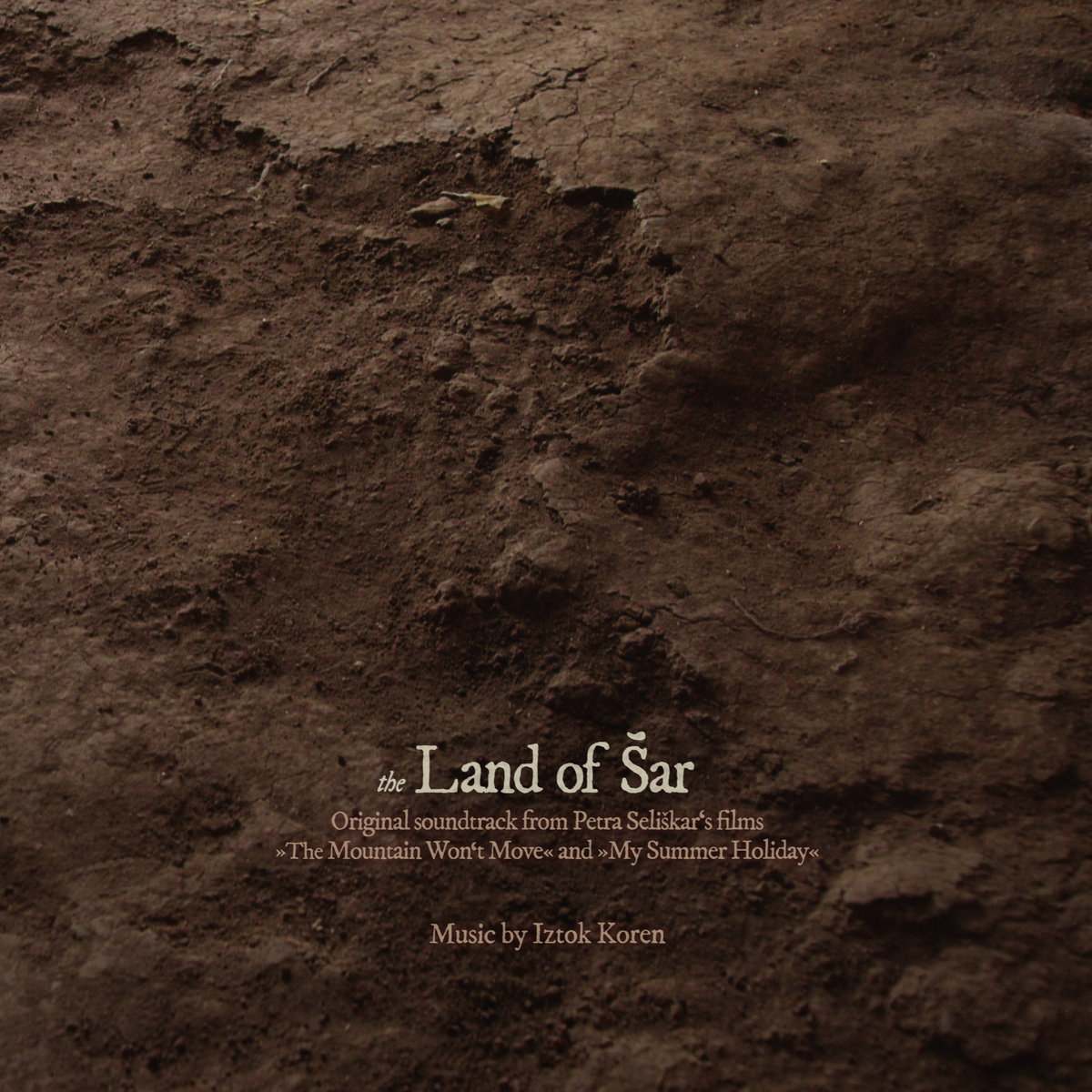
Iztok Koren's original music for The Mountain Won't Move and its sibling film My Summer Holiday, with a new long piece that links both films. Released on CD and digitally by Murmur Records, 2026.
Listen on murmur.si Review: Glasbena paša po Šar planini (Jan Kopač, Odzven / SIGIC, in Slovenian)
ProductionPetra Pan Film
petrapanfilm@gmail.com
Co-productionCinéphage Productions
cinephage@cinephage.fr
Co-productionPPFP
ppfp.skopje@gmail.com
World salesOpen Kitchen Films
Petra Pan Film
petrapanfilm@gmail.com
Press kitDownload PDF (English, 7.6 MB)